It thinks out loud
Instead of a bare answer, the model surfaces its constraints, assumptions, proposals and insights, so you can steer the reasoning, not just react to the result.
The workflow the whole product is built around: run many spaces in parallel, spawn visible, steerable subagents, and get returns bounded by information, not by turns. You answer the front that needs you; the rest keep working.
The split into ingest / api / worker is sound. One sharp edge: the worker and the api both write sessions, so the boundary has to own a single writer — or you reintroduce the exact race we just fixed in the token store.
Trade-offs
Answer below, or type a direction in plain language.
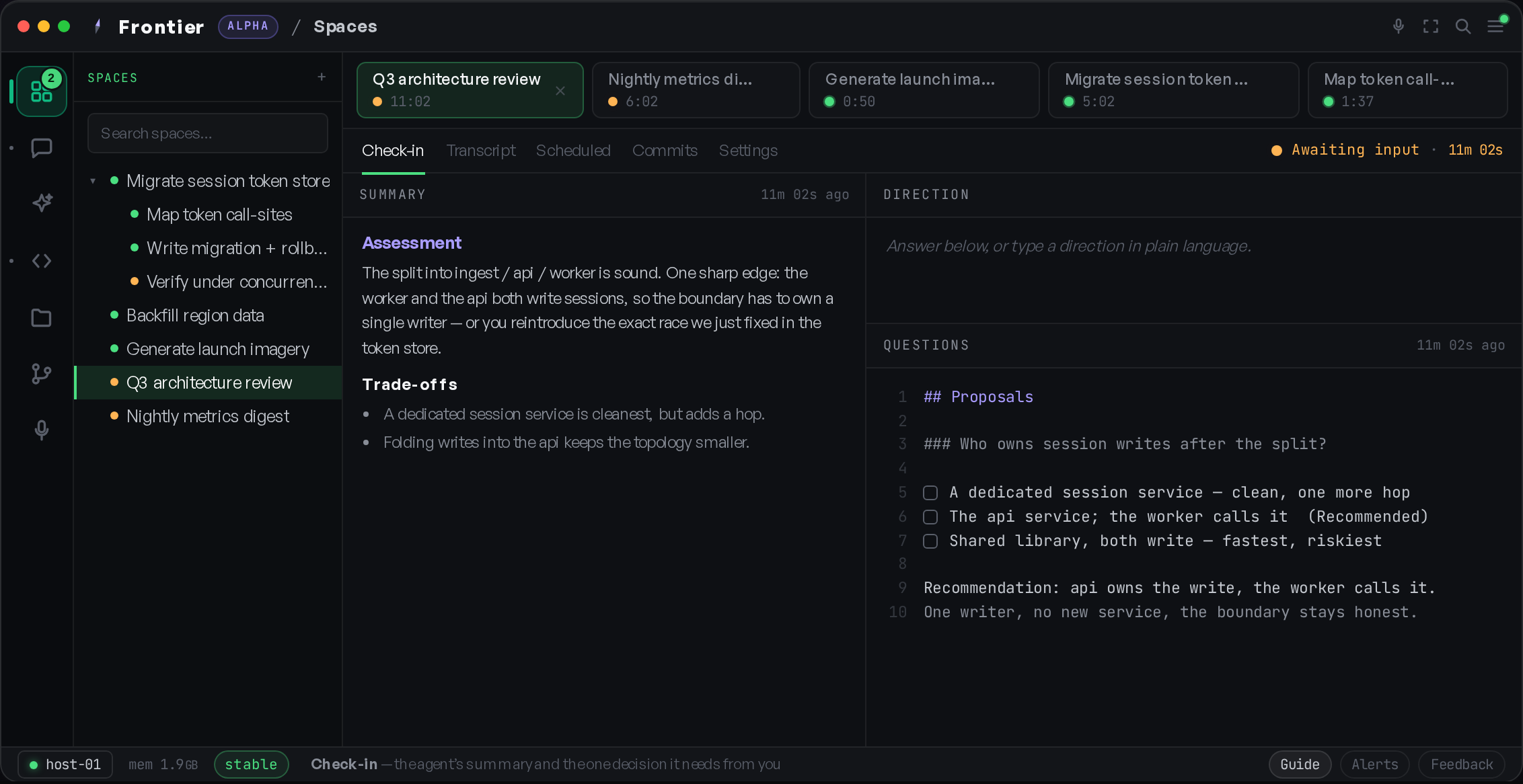
Click a tab to switch fronts; answer the one that’s hit an information boundary while the rest keep working.
Agents produce faster than anyone can review: walls of diffs, walls of text. So Spaces makes every return count. The model keeps working until it hits a genuine information boundary, a decision only you can make, and when it comes back, it's done the thinking, not just dumped output. To get there, it makes each exchange far richer than a chat message.
Instead of a bare answer, the model surfaces its constraints, assumptions, proposals and insights, so you can steer the reasoning, not just react to the result.
A running picture of the work stays pinned in view. Focus survives even on long sessions, and you can drop back in after an hour without re-reading everything.
When words run out, it sketches architecture, flows, and trade-offs on an Excalidraw canvas you can edit and hand straight back.
Answer a structured questionnaire, write freeform direction, or draw your response. Whatever closes the gap fastest.
The result: fewer, higher-quality returns and longer productive runs. The model only taps you on the shoulder when it genuinely needs a decision, so you can hold more fronts at once without drowning in half-finished output.
In most tools a subagent is a black box: it spawns, it churns, and you learn how it went only when it returns, too late to stop the tokens it just burned going the wrong way. Frontier's subagents are spaces nested under spaces: out-of-process, fully visible, and yours to step into mid-run.
Open a child and you're inside its work: its reasoning, its proposals, its diffs. No spinner, no waiting to find out how it went.
Answer a question, correct a wrong turn, or take the wheel, all without killing the work it's already done. They're steerable, not fire-and-forget.
A child can run Claude while the parent runs GPT, or a cheap local model for the grunt work. The right tool on every branch of the tree.
Spaces is a flagship core extension. Retune it, fork it, delete it, or write your own.
Frontier’s desktop app runs on macOS, Windows & Linux — open this page on your computer to download.